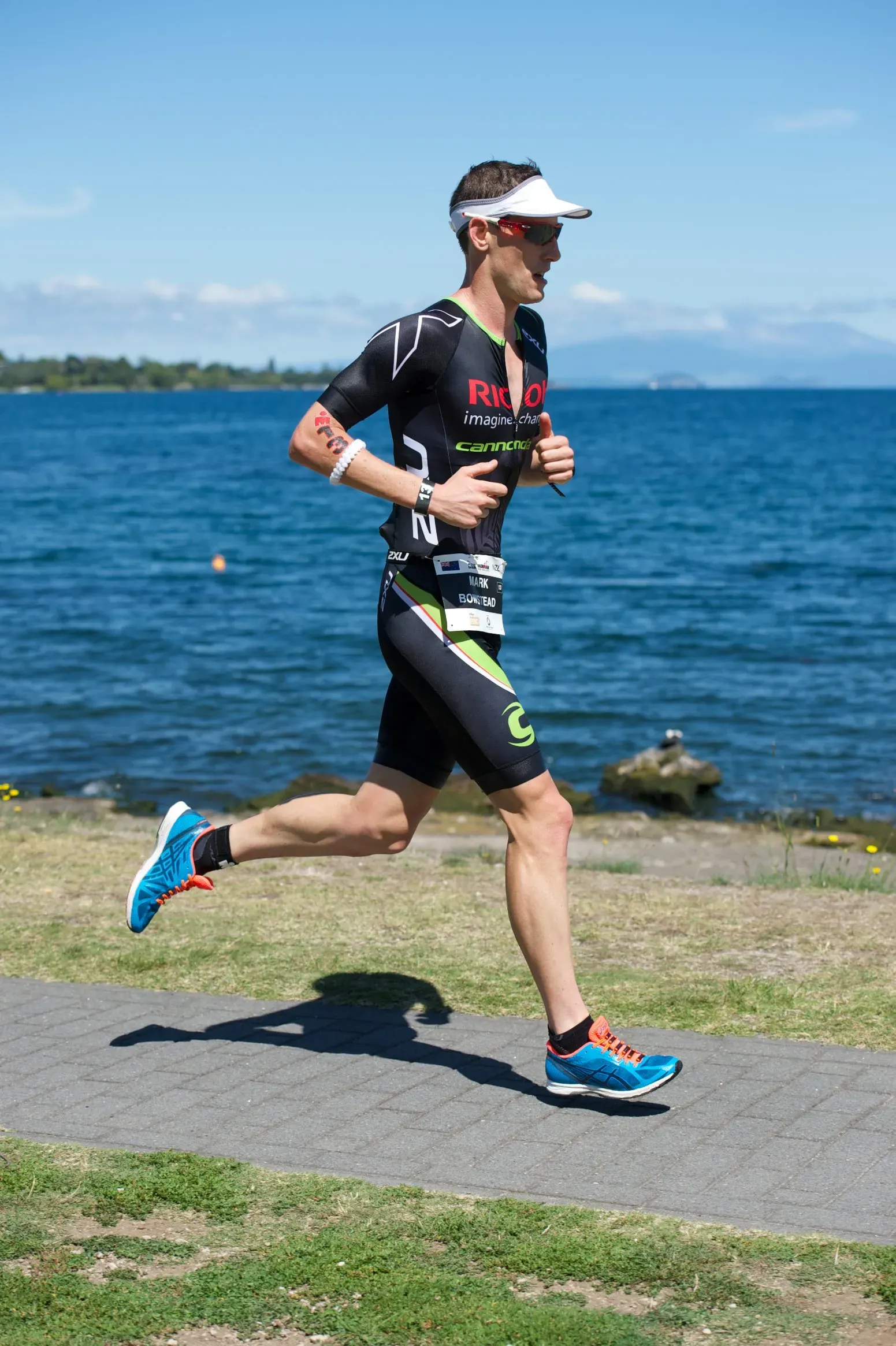
IRONMAN 70.3 New Zealand is in Taupō on Saturday 6 March 2027, so a build from Monday 9 November 2026 gives you 17 weeks, with race day on the Saturday of week 17. That’s enough to race it well on 10 hours a week around a full-time job, as long as 10 is the floor and you use more when you can find it. Here’s the plan I’d give an athlete starting now.
The course, briefly
The 70.3 races the same day, lake and town as the full IRONMAN New Zealand. It starts on the beach in Lake Taupō, rides 1 lap of the 2027 bike loop out past the Aratiatia Dam on chip-seal country roads, then runs 2 laps along the lakefront. IRONMAN’s course page puts the water at around 19 degrees.
How the wind and chop change the build is on my Taupō course training page. The short version: on a calm day it’s fast, and on a windy day it’s one of the hardest races I’ve done.
What 2 of my Taupō races taught me
I raced IRONMAN New Zealand here as a pro, and the 2 races I wrote up at the time were opposite days. Both were the full distance, and the bike course has changed since. But the lake, the hill out of town and the wind are the same ones you’ll race.
2016 was calm, and I still rode too hard. My power plan said 270 to 275W. I rode the first 15km at 310W, chasing a group up the first hill, before I made myself back off.
I went 8:29:38 and that was only good enough for 10th (my 2016 report). On a 70.3 it matters more, because the bike is 1 lap and there’s no second lap to fix it on.
2017 blew a gale. The lake was chopped up and I swam 3.5 minutes slower than the year before. On the old out-and-back I hit 79km/h with the tailwind, then rode home into the headwind at under 25km/h for long stretches.
At 20km of the marathon I stopped and stood there for a minute. I was empty. A gel and a drink at special needs had me running again inside a couple of minutes, and I finished 5th (my 2017 report).
So the 2 things I’d build in for Taupō are riding to power into a headwind, and eating on the bike to plan whatever the wind is doing.
17 weeks on 10 hours
Here’s how I’d split the build from Monday 9 November 2026. At 10 hours, roughly 2 go to swimming, 5 to the bike and 3 to running.
That’s the top of the band I give most of my 70.3 athletes, who train around 40 to 60 hour jobs (the full hours breakdown is here).
| Phase | Dates | Weeks | Hours a week | The point of it |
|---|---|---|---|---|
| Base | 9 Nov to 13 Dec 2026 | 5 | 10, with 1 easier week | Aerobic volume, swim technique, run frequency |
| Build | 14 Dec 2026 to 31 Jan 2027 | 7 | 10 to 12, with 2 easier weeks | Race-pace bike work, longer long ride, weekly bricks |
| Race-specific | 1 Feb to 21 Feb 2027 | 3 | 10 to 12 | Goal-pace sessions on race-day timing, headwind work, full fuel rehearsal |
| Taper | 22 Feb to 6 Mar 2027 | 2 | 6 to 7, then about 2 plus race day | Keep the intensity, drop the volume |
10 is the floor for this plan. If you can find more, the cheapest place for it is easy riding: in my athletes’ numbers, even 1 extra hour of easy riding a week shows up as better efficiency.
And if you’re on 6 or 7 hours now, don’t jump straight to 10 in week 1. Climb to it across the base weeks.
Christmas and New Year land in weeks 7 and 8, early in the build. Christmas takes 2 weeks off most athletes I’ve coached, so if that’s you, take them easy and let January carry the load. If the holidays free you up instead, that’s where a working athlete banks a bigger week.
Week by week
Counted back from race day. Every week starts on a Monday.
| Week | Monday | Phase | Hours | Long ride | Long run |
|---|---|---|---|---|---|
| 1 | 9 Nov 2026 | Base, test week | 10 | 2h | 1h15 |
| 2 | 16 Nov 2026 | Base | 10 | 2h15 | 1h15 |
| 3 | 23 Nov 2026 | Base | 10 | 2h30 | 1h30 |
| 4 | 30 Nov 2026 | Base, easier week | 7 | 1h30 | 1h |
| 5 | 7 Dec 2026 | Base | 10 | 2h30 | 1h30 |
| 6 | 14 Dec 2026 | Build | 10 to 11 | 2h45 | 1h30 |
| 7 | 21 Dec 2026 | Build, Christmas | 10 to 12 | 3h | 1h45 |
| 8 | 28 Dec 2026 | Build, New Year | 10 to 12 | 3h | 1h30 |
| 9 | 4 Jan 2027 | Build, easier week | 7 | 1h45 | 1h |
| 10 | 11 Jan 2027 | Build | 10 to 12 | 3h | 1h45 |
| 11 | 18 Jan 2027 | Build | 10 to 12 | 3h15 | 1h30 with race-pace |
| 12 | 25 Jan 2027 | Build, easier week | 7 | 2h | 1h |
| 13 | 1 Feb 2027 | Race-specific | 10 to 12 | 3h15 with race-pace blocks, brick off it | 2h |
| 14 | 8 Feb 2027 | Race-specific | 10 to 12 | 3h30, brick off it | 1h30 with race-pace |
| 15 | 15 Feb 2027 | Race-specific | 10 to 12 | 3h30 race rehearsal at race-day timing | 2h |
| 16 | 22 Feb 2027 | Taper | 6 to 7 | 2h | 1h15 |
| 17 | 1 Mar 2027 | Race week | about 2, plus race day | Race, Saturday 6 March | Race |
The easier weeks drop to about 7 hours on purpose. That’s where the work from the weeks before turns into fitness.
The long run never goes past 2 hours, and a 2-hour run never lands in back-to-back weeks. A 70.3 doesn’t need more, and 2-hour runs on consecutive weekends are hard to absorb around a working week.
If you’d rather have this set out to your own hours as structured workouts in TrainingPeaks, a 17-week 70.3 training plan from 9 November 2026 is NZ$229.
What never gets cut
Weeks shrink. A work trip, a sick kid, a deadline. When I rebuild a week around fewer hours, the long ride stays and run frequency stays.
The long ride decides whether your half marathon has a back half. Run frequency keeps you healthy: 3 shorter runs a week beat 1 long one for injury risk, so when time’s short the runs get shorter before they get fewer.
The bigger point is the key sessions. Across 86 four-week blocks from 27 of my athletes, blocks where they hit at least 80% of their key sessions progressed 93% of the time. Below 50%, it was 24%.
Completing every session mattered less. Blocks under 75% of all sessions still progressed 55% of the time (the full data is here).
When a session was missed and we knew why, work and life were behind 41% of them, and illness 24%. So don’t make up a missed session with a 9pm trainer ride. Skip it, keep the week normal, and protect the next key session.
Pacing the day
Ride the hill out of town at your number, even when the group goes. In 2016 I was 35W over my own plan inside the first 20 minutes, and the only one watching my power file was me.
In the wind, ride to power and ignore your speed. Hold the number into the headwind, and don’t ease off when the tailwind makes it feel free.
Then run the first of the 2 laps easier than you want to. I wrote up 3 race files from one weekend that show what an overcooked bike does to the run.
If you’re racing Tauranga or Geelong too
The Tauranga Half is on Saturday 23 January 2027, exactly 6 weeks before Taupō, on the Saturday of week 11. That’s about where I’d put a dress rehearsal: race it, take week 12 as the easier week, then go into race-specific. How that flat course changes a build is on my Tauranga Half training page.
70.3 Geelong is 15 days after Taupō, on Sunday 21 March 2027. If you’re doing both, I’ve covered the 2 weeks between them in the 70.3 Geelong guide.
Common questions
When should I start training for 70.3 Taupō 2027?
Monday 9 November 2026 gives you a 17-week build to race day on Saturday 6 March 2027. That’s 5 weeks of base, 7 of build, 3 race-specific and a 2-week taper. The latest start for a 12-week plan is Monday 14 December 2026, and that only works off an existing base.
Is 10 hours a week enough for 70.3 Taupō?
10 hours a week is a good floor for Taupō: it gets a working athlete there ready to race the whole half marathon. If you can find more, use it, and make the extra hour easy riding. Competitive age-groupers usually sit closer to 10 to 14.
How long should my long ride and long run be for a 70.3?
Build the long ride to about 3h30 and cap the long run at 2 hours. On 10 hours the long ride carries the most weight, with race-pace blocks inside it from the build on. Keep 2-hour runs out of back-to-back weeks.
Can I race the Tauranga Half as a tune-up for Taupō?
Yes. The Tauranga Half on 23 January 2027 is 6 weeks before Taupō, about where I’d put a dress rehearsal. Race it, take the next week easier, then start your race-specific block.
If you want this built around your actual week, that’s what I do. Get in touch and tell me your race and the hours you’ve realistically got. If it looks like a fit, we set up a time to chat.
If you’d rather run it yourself, start with the 70.3 training plan. How coaching works and what it costs is on the coaching options page.
Mark Bowstead raced professionally from 2012 to 2020 and has coached endurance athletes since 2017 through Bowstead Performance Coaching, from Auckland. He won IRONMAN 70.3 Buffalo Springs in 2015. His fastest Ironman was at Taupō: 8:16:13 for 7th at IRONMAN New Zealand in 2020.