Challenge Wānaka 100 is a 2km swim in a cold lake, an 80km ride on rough chip seal with steep climbs, and an 18km run on lakeside trails. It’s the hardest of the New Zealand races on terrain. You’ll be out there longer than the distances suggest, and your training needs to look different from a flat-course build.
It’s on Saturday 20 February 2027. From 2027 it’s the Wānaka 100 rather than a half: the bike is 10km shorter and the run 3.1km shorter than the old race. The full season dates are on the NZ triathlon season page.
The swim: cold, fresh and less buoyant
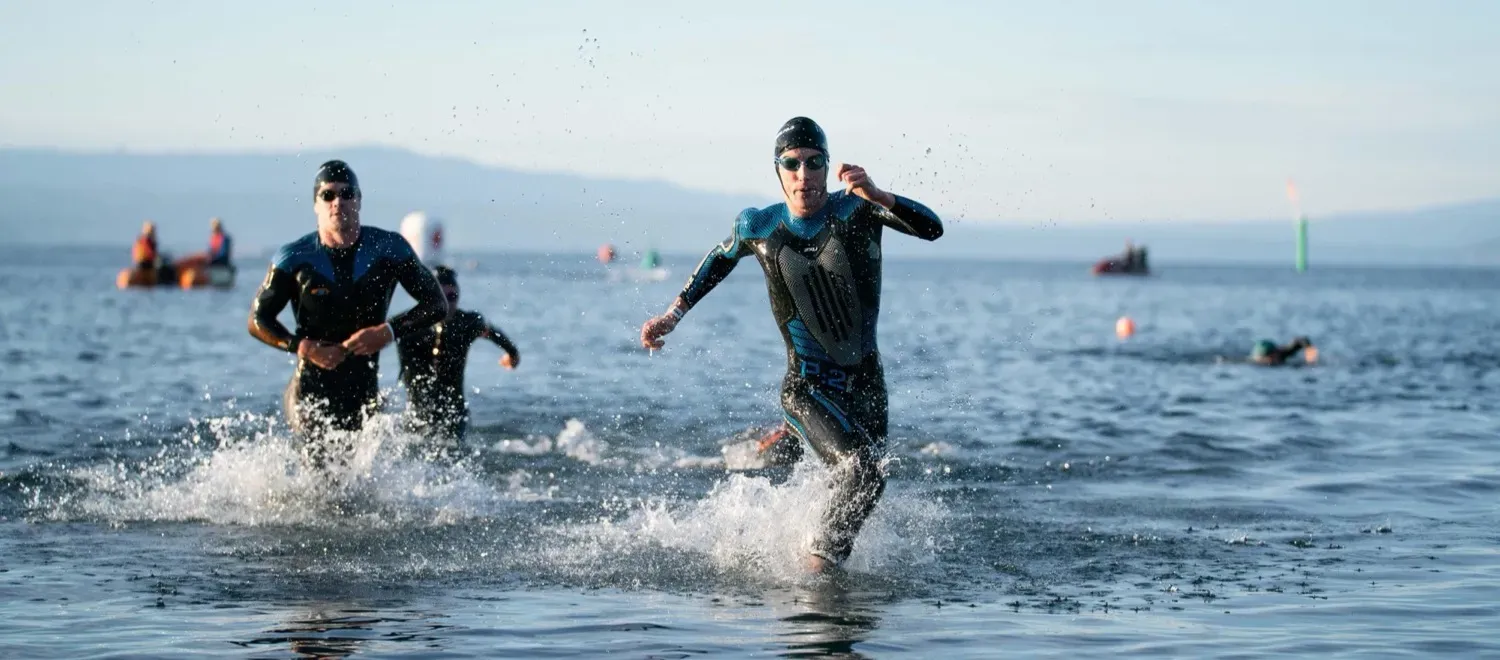
The swim is one lap of Roys Bay on Lake Wānaka. The organisers put the water at around 15 to 17 degrees on race day, and wetsuits are compulsory.
2 things make it harder than a sea swim.
Fresh water floats you less. Your legs sit lower and you work harder for the same speed. If your kick is weak or your hips drop when you’re tired, a lake shows it up. Do most of your open-water swims in your wetsuit, and in a lake if you have one near you.
It’s cold. Cold water takes your breath at the start and makes your hands clumsy. Get at least 4 or 5 swims in cold open water before race day. Practise the first 200m: start steady, get your breathing under control, then build. A neoprene cap or earplugs help some athletes a lot.
Lake chop can make it harder still. Practise sighting every 6 to 8 strokes so a bit of wind doesn’t send you off line.
The bike: rough, steep and slow
The official route for the new 80km bike is still to come on Challenge Wānaka’s race page (checked 18 October 2026). But the roads around Wānaka don’t change, and they set the training.
The surface is rough chip seal. The climbs are short and steep. And the wind off the lakes can be strong.
That adds up to one thing: you’ll be on the bike for longer than 80km sounds. Rough chip seal is slow. You can push the same watts as on a smooth road and go noticeably slower. Add the climbs and you might spend as long on this bike as on a flat 90km.
Train for time, not distance
Plan your long rides in hours, not kilometres. If you expect to ride 2 hours 45 minutes on race day, your longest rides need to get to 3 to 3.5 hours by the last 6 weeks. That’s longer than an athlete racing a flat 90km at Tauranga would need.
Take your fuelling up with it. More time on the bike means more carbohydrate in total, so practise taking in your race-day rate across the full length of your long rides.
Climbing strength
Steep gradients mean low cadence and big force through the pedals, whatever gears you’re running.
- Seated big-gear climbs: 5 x 5 minutes up a real hill at 60 to 70rpm, around threshold. Build to 4 x 8 minutes.
- Hilly long rides: at least every second long ride should have climbing in it. If you live somewhere flat, use the trainer with the resistance up, or find the one hill you’ve got and ride it 6 times.
- Short, steep surges: practise going over a steep pinch without spiking your power. On race day the athlete who stays steady on the climbs runs better.
Ride rough roads in training
If you only ever train on smooth roads, chip seal will shake you up. Do some long rides on rough roads. You’ll learn how to stay relaxed, how your bike handles and how it feels to push power for less speed.
Gear and tyres matter more here than at most races. Think about lower gearing for the steep sections, and wider tyres at a lower pressure for the rough surface. Test any change in training, never on race day.
Descend with confidence
What goes up comes down, on rough roads, sometimes in a crosswind. Practise descending on similar roads. Time lost from nerves on a descent is the cheapest time to get back.
The run: rolling trails by the lake
The 18km run is 2 laps out and back from the township, along the lakeside trail to Beacon Point. It’s mostly sealed paths and good trail, rolling, with a steep climb just after 7km up to the Beacon Point Road footpath.
- Run some of your easy runs on trails. Gravel and dirt use your ankles and hips differently from the road.
- Practise short, steep climbs on tired legs, like the end of a long run, or straight off the bike in a brick.
- Pace by effort on the hills. Don’t try to hold your flat-road pace up the climb. Ease off on the way up, then let it roll on the way down.
How it differs from Tauranga and Taupō
At Tauranga the challenge is holding one aero position for over 2 hours on a dead flat road. At Wānaka it’s the opposite: the terrain keeps changing and the challenge is strength and time on your feet.
If you’re racing both, build the aero time for Tauranga in January, then switch to more hills and longer rides for the 4 weeks into Wānaka.
Common questions
Is Challenge Wānaka harder than the Tauranga Half?
On terrain, yes. The bike is shorter but slower, with rough chip seal and steep climbs, and the run rolls on trails. Most athletes take longer per kilometre at Wānaka than at Tauranga.
Do I need a road bike or a TT bike for Wānaka?
Ride whichever you can climb and descend well on. A TT bike still pays off on the flatter sections and into the wind, but lower gearing and confident handling matter more here than at a flat race.
How cold is Lake Wānaka for the swim?
The organisers expect about 15 to 17 degrees on race day, and wetsuits are compulsory. Practise in cold open water before the race, so the first few minutes don’t catch you out.
How long should my long rides be for Challenge Wānaka 100?
Go by time. Work out how long you’ll ride on the day, then build your longest rides to 30 to 45 minutes past that by the last 6 weeks, with climbing in at least half of them.
Work with me
I coach from Auckland, 1-on-1 through TrainingPeaks. If Wānaka’s your race and you want a build that’s ready for those roads, get in touch and tell me how many hours you’ve realistically got. If you’d rather race off a fixed plan, my 70.3 training plan is built from your race date and your hours.
Mark Bowstead raced as a professional triathlete from 2012 to 2020 and has coached endurance athletes since 2017 through Bowstead Performance Coaching. He’s based in Auckland and coaches athletes online through TrainingPeaks across New Zealand and Australia.