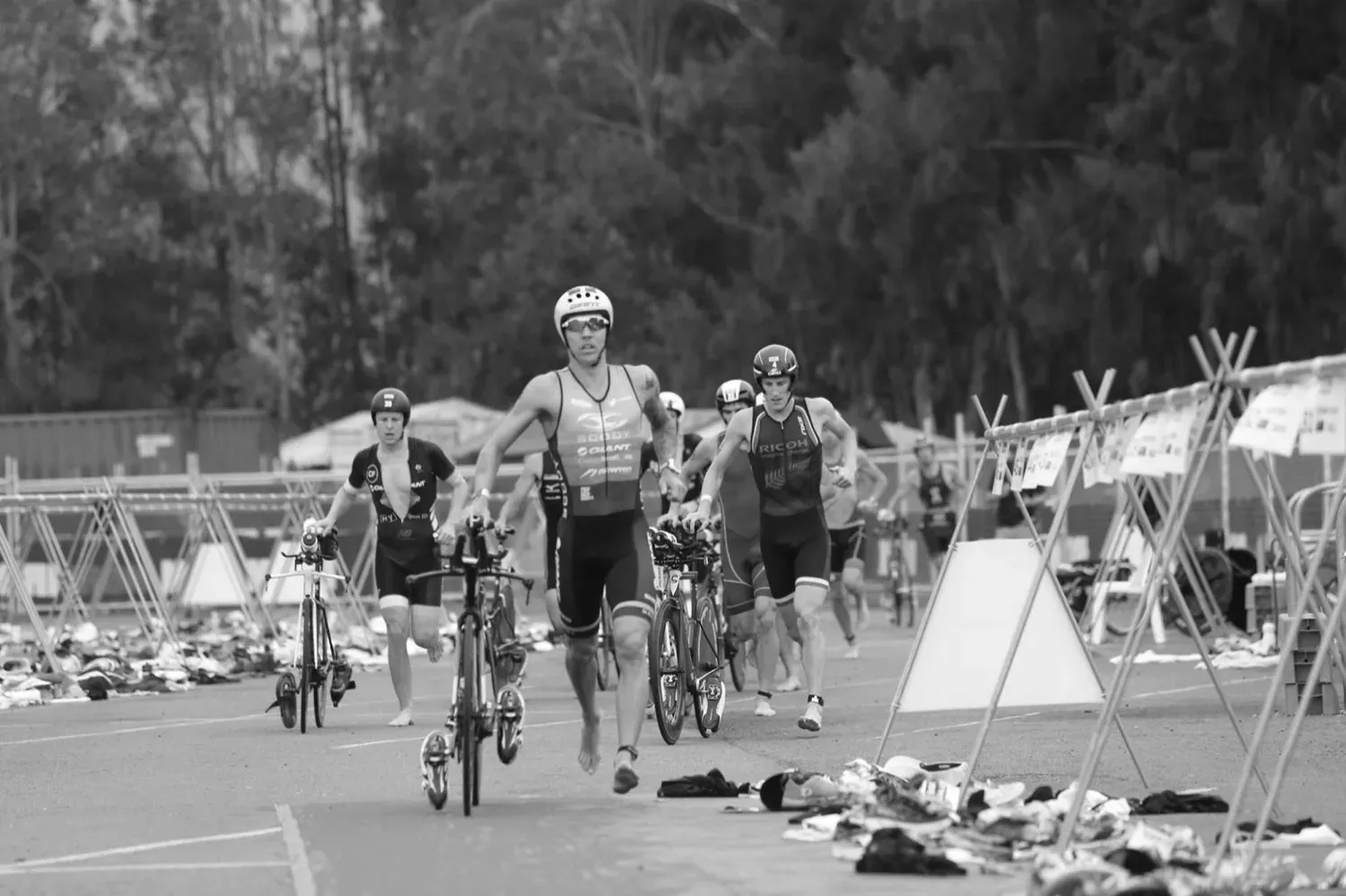
If you’re a triathlete over 40, you can still get fitter and faster. Your body still responds to hard training. What changes is how long it takes to bounce back, so I keep the hard sessions hard and give you more space around them. And I decide how much of that you need by watching how you handle the training, with your age only as the reason to start looking.
Take 2 athletes who are both 52. One has 15 years of steady training behind them and recovers overnight.
The other started 3 years ago and still feels a hard run for days. They shouldn’t get the same plan.
Your age tells me when to look
I start checking how an athlete copes at around 40 for men. For women I start a bit earlier, from about 35 to 40, because perimenopause can begin changing recovery sooner.
What I look at is your own training record:
- Do you get the sessions done? Compliance over months says a lot about whether the load fits.
- How do you feel the day after a hard one? Some athletes are fresh in 24 hours. Some need 48.
- Is the same power or pace starting to feel harder? If your effort rating creeps up for the same numbers over a few weeks, recovery is falling behind.
From that, you’ll get one of 3 settings: no change, a light touch or the full set of adjustments. I check it again at the end of every training block, and it moves both ways. An athlete on the full set who handles 3 blocks cleanly moves to the light one.
Fit, experienced athletes with big engines usually need less adjustment than you’d expect. I’d rather prove you need it than assume it because of a birthday.
The hard sessions stay hard
Trained athletes in their 50s and 60s still adapt to the same hard work as athletes in their 30s. So your intervals stay at the same intensity. Your zones come from your own test results, the same way they would at any age.
The thing I’m most careful to avoid is turning a masters plan into easy riding and gentle jogging out of caution. That costs you speed, and you don’t get it back by training longer.
What changes
More space after the sessions that hurt your muscles
Hard downhill running, heavy strength work and jumping drills all cause small amounts of muscle damage. As you get older, that damage takes longer to repair. On the full setting, I leave 48 hours between one of those sessions and your next key workout, where a younger athlete might get 24.
I do the same with hard interval days that would otherwise land back to back. Same quality, more air between them.
Easier weeks that are properly easy
Your easier weeks cut volume a bit deeper, closer to 40% less than a normal week. You still train most days, and you still get a short bit of quality in that week, so you stay sharp. If your recovery says so, the easier week comes every third week instead of every fourth.
When time is short, the intervals stay
Life gets busy and something has to go. When I trim your week, I cut the long easy volume first. The short, hard efforts and your strength sessions are the last things to go, because they’re the fitness that fades fastest with age, and extra easy hours don’t replace them.
Often that means fewer reps in a session at the same intensity, with that session coming round more often in the week.
Strength is part of the plan
Heavy strength work and some fast, explosive work (jumps, short sprints) are the most direct way to hold on to muscle and power as you age. For a younger athlete they’re a useful add-on. For you they’re one of the sessions I protect when the week gets cut, and you do some all year, apart from times when an injury rules them out.
More protein
Older muscle needs more protein to get the same repair from training. For endurance athletes, the masters research points to about 1.8g per kg of body weight a day (Moore, 2021). That’s around 135g if you weigh 75kg.
Spread it over 4 or 5 meals of 0.3 to 0.4g per kg, with a bigger serve (about 0.5g per kg) after your hard sessions.
Trends matter more than one bad morning
Masters athletes have more ups and downs from one day to the next. So one flat morning means less, and a run of them means more. I look at your resting heart rate trend and how you rate your sessions over a week or two before I change the load.
What athletes say
None of the athletes below are quoted because of their age. These lines are about the parts of the coaching that matter most for a masters athlete.
On being asked how a session felt, as well as what the numbers said:
Even when the data suggested I could push harder, he always asked how the session actually felt.
Damon Clark
On strength training:
We were also aligned on the importance of strength training, which has now become a regular part of my routine and has made a huge difference to my ability to keep training consistently.
On staying healthy:
Perhaps most importantly, I stayed injury-free by training with the right balance and intent, and I gained a deep understanding of training principles that I’ll carry with me for years to come.
More on the testimonials page.
Common questions
Is 50 too old to start triathlon?
No. Plenty of people start in their 50s and keep improving for years.
Start with consistency before intensity: a few months of regular easy training builds the base the harder sessions need. The research on masters athletes adapting like younger ones is mostly in people who are already trained, so the first year is about getting you there.
Do masters triathletes need more recovery?
Yes, but mostly after particular sessions. Hard downhill running, heavy strength and jumping drills need more time before the next key workout.
Your easier weeks also cut a bit deeper. How much more you need depends on how you’re handling the training, and I check that every block.
Should I stop doing intervals after 40?
No. Short, hard efforts are the fitness that fades fastest with age if you stop doing them.
Keep them in. When your week is short on time, drop easy volume before you drop intervals.
How many hours a week does a masters triathlete need?
About the same as anyone else training for the same race. For a 70.3, 8 to 10 hours a week gets most working athletes to the finish. Age changes how I space the hard sessions inside those hours more than how many hours you need.
Does strength training matter more as you get older?
Yes. It’s one of the sessions I protect first for a masters athlete, because it’s the most direct way to hold on to muscle and power.
Work with me
I coach from Auckland, 1-on-1 through TrainingPeaks. If you’re over 40 and want a plan set by how you’re actually coping, get in touch. Tell me your race, your hours and how long you’ve been training.
Mark Bowstead raced as a professional triathlete from 2012 to 2020 and has coached endurance athletes since 2017 through Bowstead Performance Coaching. He’s based in Auckland and coaches athletes online through TrainingPeaks across New Zealand and Australia.