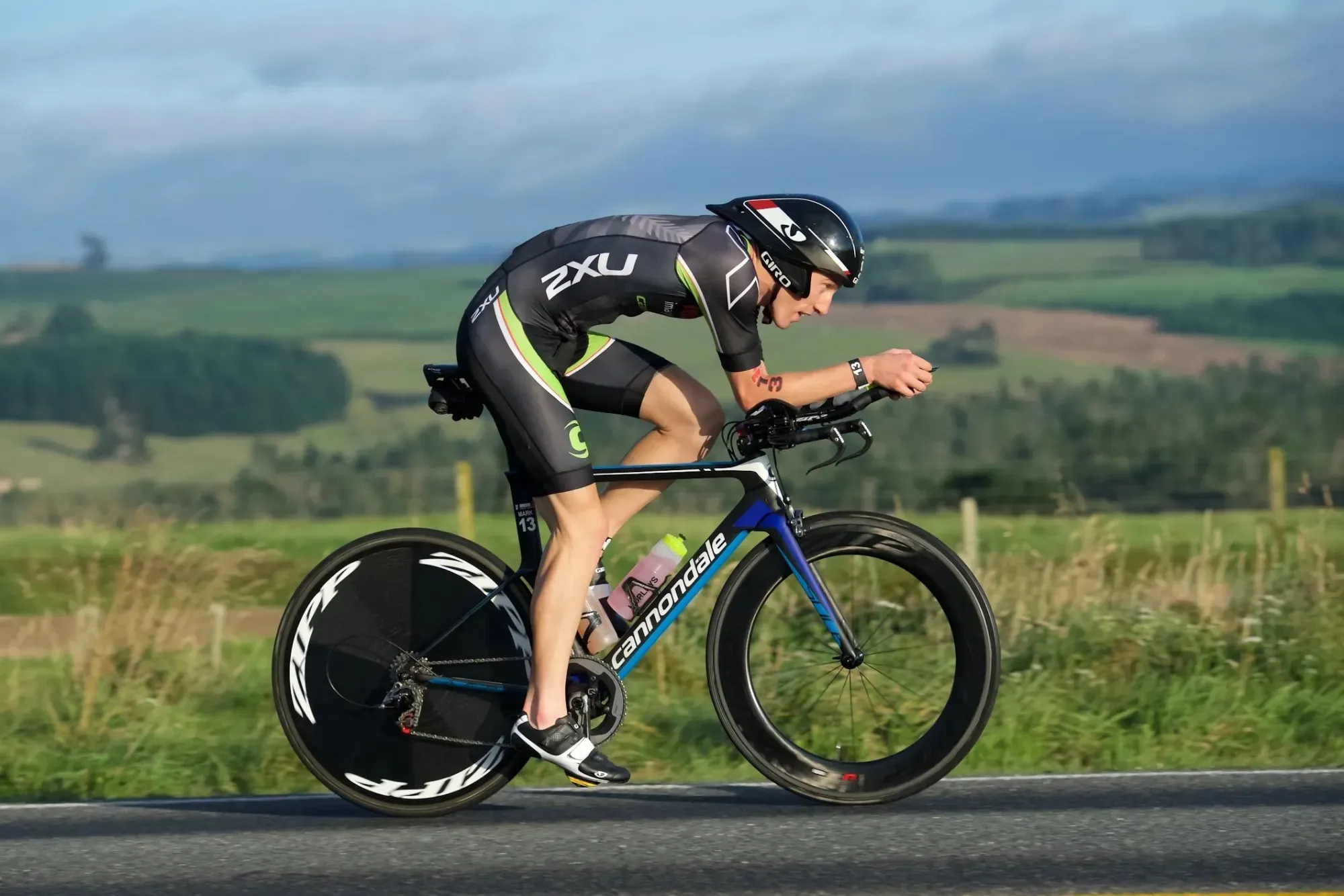
Yes, you can build to IRONMAN New Zealand on 10 hours a week. I’ve coached plenty of athletes who did it around 40 to 60 hour jobs. It’s tighter than the 10 to 14 hour band I usually quote for a full Ironman build, so the shape of the week has to be exact: nothing wasted, nothing left to feel. Treat 10 as the floor, not the target. The more endurance you can build, the better your day goes, and in my athletes’ numbers even one extra hour of easy riding a week shows up as better efficiency. Taupo is my home race and I’ve started it twice as a pro, once in the calmest conditions I’ve ever seen there and once in a gale. Both times the same two sessions decided the day. Here’s the training plan: what 10 hours actually buys you, what it costs, and the week that makes it work.
IRONMAN New Zealand runs on Saturday 6 March 2027 in Taupo. The swim is 3.8km in Lake Taupo. The bike is 180km, 2 laps of a loop out past the Aratiatia Dam, with real wind somewhere on every lap. Then a marathon along the lakefront and through town, finishing on the red carpet in front of a crowd like nothing else I raced in nine seasons as a pro. With 26 weeks to go, you are right in the window where the build has time to work. If you want your week set out to the 6 March date, my Ironman training plan is built around the hours you have. If you can find more than 10, use them.
Where the 10 hours go
The split isn’t even, and it shouldn’t be. Your bike gets the biggest share at 10 hours a week. It’s roughly half your race by time, and the cheapest place to build fitness without breaking down. Swim and run then trade space with each other as the block moves from base to race-specific.
-
Swim: Base phase 1h30, Race-specific phase 1h
-
Bike: Base phase 5h30, Race-specific phase 5h30
-
Run: Base phase 3h, Race-specific phase 3h30
-
Total: Base phase 10h, Race-specific phase 10h
The bike holds steady through the whole build. Swim gives up 30 minutes as race day nears. A 3.8km swim is only around 10% of your day, and technique holds up on less volume than most athletes expect. Run picks that 30 minutes up. The last 8 weeks are where race-pace fitness for the run actually gets bought.
What gets cut first, and why
Weeks shrink. A work trip, a sick kid, a deadline that eats your Tuesday evening. When I rebuild a week around fewer hours, the order matters more than most athletes expect.
The extra easy bike session goes first. Friday’s shakeout spin is nice to have and does almost nothing your body will miss.
Then the swim, and it goes harder than most athletes want. Two purposeful swims a week hold your technique through a full Ironman build. A third swim adds fitness, but you can buy that same fitness back on the bike for a fraction of the time. So when the week is tight, swim frequency drops to 2 before anything else touches the water.
The middle-intensity stuff goes next. Those sessions that feel productive because they’re hard, but don’t sit clearly in an easy bucket or a race-specific one. I wrote about this trap in the zone 2 guide: moderate effort mostly just generates fatigue without buying you anything specific.
What doesn’t move is the long ride and the long run, and I’ll get to why below. On 10 hours, those 2 sessions add up to close to 45% of your week by themselves. Everything on the other 5 days exists so you can show up to Saturday and Sunday able to do the work.
The sessions that cannot be cut
Two sessions hold the whole build together. I protect them the way I protect anything that matters: I plan the rest of the week around them, not the other way round.
The long ride is first. It’s the session that decides whether your marathon has a back half, because bike durability is what protects your run in a full Ironman. Cut it in a genuinely bad week if you have to, but it stays on the calendar every other week of the build.
Run frequency is second, and this one surprises people. How often you run matters more here than how long any single run is. Three short runs a week beat one long one for injury risk on limited hours, and running is where limited-hours athletes get hurt. So when run time has to shrink, the runs get shorter before they get fewer.
The long run itself has a ceiling, and it doesn’t move much even for a full Ironman: 90 to 120 minutes at a conversational pace. I’ve written about why elsewhere. The short version: your legs get built for the marathon mostly on the bike, through the long ride and the brick off it. Not by grinding out 3-hour training runs that add injury risk with little to show for it.
And the brick, the short run straight off the long ride, doesn’t get cut either. It’s the cheapest race-specific session on the whole calendar. Just 10 to 30 minutes, and it teaches your legs what running on tired legs feels like, for a fraction of the time cost of a genuinely long run.
How the long ride works when you can’t ride 6 hours
A 6-hour ride is the classic advice for the last long rides before a full Ironman, and on 10 hours a week you simply don’t have one. 6 hours is 60% of your entire training week gone in a single session. It doesn’t fit, and forcing it in is how a build ends at the physio rather than the start line.
So the long ride caps out lower, around 3h30 to 3h45 through the peak of the build, and 2 things make up the difference.
The first is effort. A shorter ride at real IRONMAN effort, paced with discipline, beats a longer ride spent riding easy because you’re scared of the distance.
And I know exactly how hard that discipline is, because I’ve failed at it on this course. My power plan for my first Ironman in Taupo was 270 to 275W. I rode the first 15km at 310W, chasing a group up the first hill, before I made myself back off. I was a pro, I’d built that number with Best Bike Split, and it was sitting right there on the screen. I still rode 35W over the top of my own band inside the first 20 minutes. The numbers are in my 2016 race report.
You’ll feel the same pull on the same hill, and nobody is watching your power file for you.
I’ve written up what happens when effort and distance don’t match: 3 race files from one weekend show how badly an overcooked pace taxes the run that follows. The same rule applies at full distance, just with more hours for it to add up over.
The second is treating the whole weekend as one session, not two. Saturday’s long ride runs straight into a brick, 10 to 30 minutes off the bike. Sunday’s long run then carries what’s left of Saturday’s fatigue. No single session touches 6 hours, but the weekend together asks your body a very similar question. And the brick is the cheapest, most race-specific minute of the whole week. That’s why it never gets cut, no matter how the rest of the week is going.
One more thing worth knowing about Taupo: the wind decides more than the distance does. I raced it in near-perfect conditions one year and rode into 79km/h gusts the next, on the same course, in the same body. Both starts are written up in full in my race archive. Durability is what a capped, honest long ride actually trains: the ability to hold your effort deep into a session no matter what the day throws at you. That matters more on this course than raw hours ever will.
And go carefully on how fast you build that long ride up. Three weeks out from my first Ironman here, I got bursitis where I sit on the saddle, purely from adding bike volume too fast. It cost me 4 to 5 days off the bike at the worst time, right when I could least afford to lose them. Build the long ride up slowly through base phase. Don’t jump it.
A sample base-phase week
Early in the build, before race-specific work starts, a 10-hour week looks like this.
-
Monday: Swim, technique and aerobic (30 min)
-
Tuesday: Bike, structured intervals on the trainer, before work (1h15)
-
Wednesday: Run, easy aerobic plus strides (55 min)
-
Thursday: Swim, main aerobic set, then a short easy run off the pool (1h + 20 min)
-
Friday: Bike, easy spin (45 min)
-
Saturday: Long ride, aerobic endurance pace, then 15 min easy running off the bike (3h30 + 15 min)
-
Sunday: Long run, aerobic, conversational (1h30)
-
Total: 10h
Nothing here is hard by feel. On limited hours, base phase leans on frequency and duration to do the work that intensity does later. Your legs arrive at race-specific training already tough, rather than fresh but fragile.
A sample race-specific week
Eight to 10 weeks out, the shape changes. Swim gives up its second easy session, run picks up race-pace work, and the long ride turns into a rehearsal rather than a base-build.
-
Monday: Rest
-
Tuesday: Bike, race-pace structured intervals, before work (1h10)
-
Wednesday: Run, tempo at goal IRONMAN marathon effort (50 min)
-
Thursday: Swim, technique and open-water pacing, then a short transition run (1h + 20 min)
-
Friday: Bike, easy spin, shakeout legs (35 min)
-
Saturday: Long ride, IRONMAN-effort blocks with full nutrition rehearsal, then a brick run off the bike (3h45 + 30 min)
-
Sunday: Long run, steady with race-pace segments (1h50)
-
Total: 10h
Saturday is the peak session of the entire build: the longest ride, the longest brick, race nutrition tested for real. Everything about the rest of the week, right down to Monday’s full rest day, exists to make sure you show up to it able to hit it properly.
Where a coach changes the answer
Everything above is a sound default. It’s also not your week, and that’s the part a template can’t fix.
A strong swimmer who’s weak on the bike gets a different split from a strong cyclist who can’t run off it, even at the same 10 hours. An athlete with a history of bike injuries needs that long ride built up slower than the table above assumes. Sometimes across 2 builds, not one.
Someone whose only real block of free time falls midweek rather than on a weekend needs the long ride and the brick moved entirely, and moving them changes what the rest of the week has to do around them.
Then there’s the week that actually happens versus the week that was planned. Work blows up, a kid gets sick, a flight gets rebooked. A generic plan just sits there, unaware anything happened. What I do differently is rebuild the week around what’s left. I don’t cram missed sessions into the days that remain. Do that and a 3-day disruption turns into a fortnight lost to fatigue.
And the honest version of this answer has a ceiling. Some athletes genuinely need more than 10 hours to race IRONMAN New Zealand well, given their history or their current fitness. Others need a longer runway than 24 weeks to get there safely. Part of the job is telling you that plainly, rather than forcing your situation to fit a number that doesn’t suit it.
That’s the case for individual coaching over a downloaded plan. The workouts themselves are mostly a variation on what’s above. What you’re actually paying for is the constant small adjustment of whose body and whose week they’re built for.
Common questions
How many hours a week do I need to train for IRONMAN New Zealand?
Most working athletes build well on 10 to 14 hours a week. 10 is the minimum, and it only works with a tightly shaped week. More is better, and an extra hour of easy riding is the cheapest place to add it. Under 10, finishing is possible but the marathon usually collects the debt.
Is 10 hours a week enough for a full Ironman?
It’s enough to finish well if the week is built around 2 non-negotiable sessions, the long ride and the long run. It’s the minimum, though, not the goal. A well-built 10-hour week beats a messy 14-hour one, but a well-built 12-hour week beats both.
How long should my longest ride be on 10 hours a week?
Around 3 hours 30 minutes to 3 hours 45 minutes at the peak of the build, ridden at genuine IRONMAN effort rather than an easy pace stretched out. A shorter ride ridden honestly beats a longer one ridden soft.
When should I start training for IRONMAN New Zealand?
24 weeks out is the sweet spot for most working athletes with an existing base. Less than 16 weeks out and I’m managing the fitness you already have rather than building what the race needs.
What’s the biggest mistake athletes make training for Taupo on limited hours?
Ramping bike volume too fast. I did it myself 3 weeks out from my first Ironman here and lost 4 to 5 days off the bike at the worst possible point in the build. Build the long ride up gradually, and protect run frequency over run length. It’s the first of the five mistakes I see most often in age-group triathletes, all in one post.
Where to from here
If you want the coaching side of this race specifically, that’s on the IRONMAN coaching in New Zealand page. How the coaching runs week to week is on the Ironman and 70.3 coaching page. And if IRONMAN New Zealand is one of a few races on your radar this season, the New Zealand triathlon season overview lays out the build-back timeline from all of them.
Current pricing is on the coaching options page: $250 a month standard, $350 premium, single sport $100 to $200. Standard is full to new athletes at the moment, so if that’s the one you want, get in touch and I’ll tell you where the queue is. No hard sell, just a conversation about your race and your week.
I’m Mark Bowstead, a triathlon coach based in Auckland and the founder of Bowstead Performance Coaching. I raced professionally for nine seasons, won IRONMAN 70.3 Buffalo Springs, and hold an engineering degree with First Class Honours from the University of Auckland. I coach time-pressured professionals through Ironman, 70.3 and marathon builds. Every plan lives in TrainingPeaks and gets rebuilt each week from what you actually did. More about my background.